Why Sub-Contractor Coordination Breaks at 15 Active Jobs
Sub-contractor coordination works at 10 jobs and fails at 15. Here is the system mid-market GCs use to scale without buying a new PM platform.
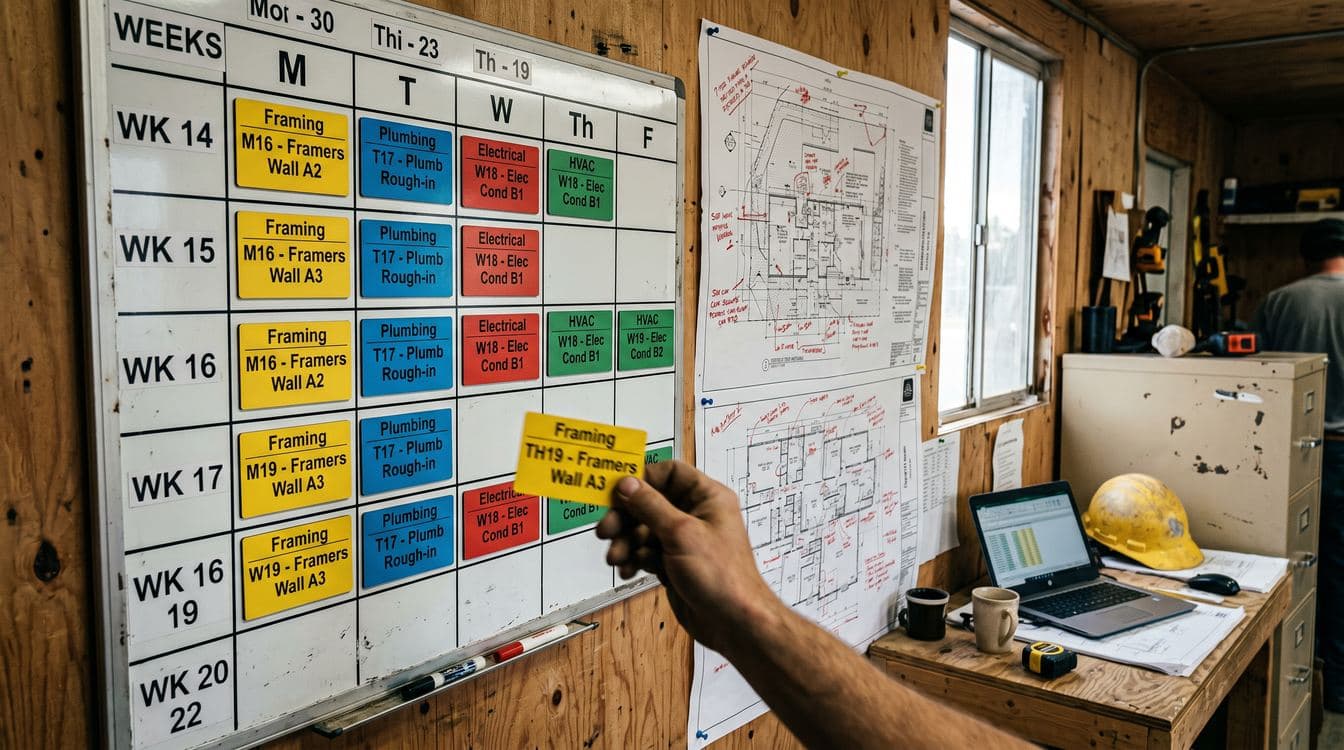
TL;DR. Sub-contractor coordination works fine when you're running 8-10 jobs. Past 15, the text chains, shared drives, and weekly all-hands calls that held your operation together start failing in ways that cost real money: missed schedule sequences, duplicated change orders, and subs showing up to a site that isn't ready for them. The fix isn't a new PM platform. It's a coordination system built on three things: structured prequalification, weekly pull planning by trade sequence, and a single documentation thread per job.
The direct answer for the GC owner reading this before the first crew rolls: stop treating sub-contractor coordination contractors do every day as a relationship problem and start treating it as throughput. At 8 jobs, your super holds every sequence in his head. At 15, the same approach burns four to six unbillable hours per active job per week. The three changes below are what mid-market GCs in the $20M-$80M range use to push their span of control from 10 jobs to 25 without hiring a second tier of operations leadership.
The 15-Job Wall Is Real, and It's Mechanical
We have watched this break at a dozen GCs over three years. The threshold is not exactly 15. Sometimes 12, sometimes 18. The factor that moves it is not project size. It is the number of concurrent active sites one superintendent layer is expected to coordinate.
According to the Project Management Institute, poor communication is a contributing factor in 56% of failed projects, and $75 million of every $1 billion spent is at risk due to ineffective communications. The Construction Industry Institute, summarized through BMD Materials, puts U.S. rework and conflict cost at $177 billion per year, with rework alone at 9% to 20% of total project cost. FMI and Autodesk attribute 26% of that rework, roughly $17 billion annually, to poor communication.
The 15-job wall is that statistic showing up in your P&L. Each missed sequence is small: $3,000 for a pour the plumber wasn't ready for, $8,000 for a framer on an unsigned slab. Stack 40 of these and you have lost a six-figure number no one line-itemed.
"We didn't realize we had a coordination problem. We thought we had a sub-contractor problem. So we fired three subs in 2023 and our numbers got worse. Then we figured out our subs were fine. We were the bottleneck."
Mid-market GC owner, central Florida, $42M annual revenue
The reason coordination breaks at 15 is mechanical. A super running 10 jobs coordinates roughly 30 active trades. At 15 jobs averaging four trades each, you cross 60 fronts and exceed the cognitive limit of one person. The wall is not motivation. It is how many threads one human reliably holds.
Fix One: Prequalification That Actually Filters
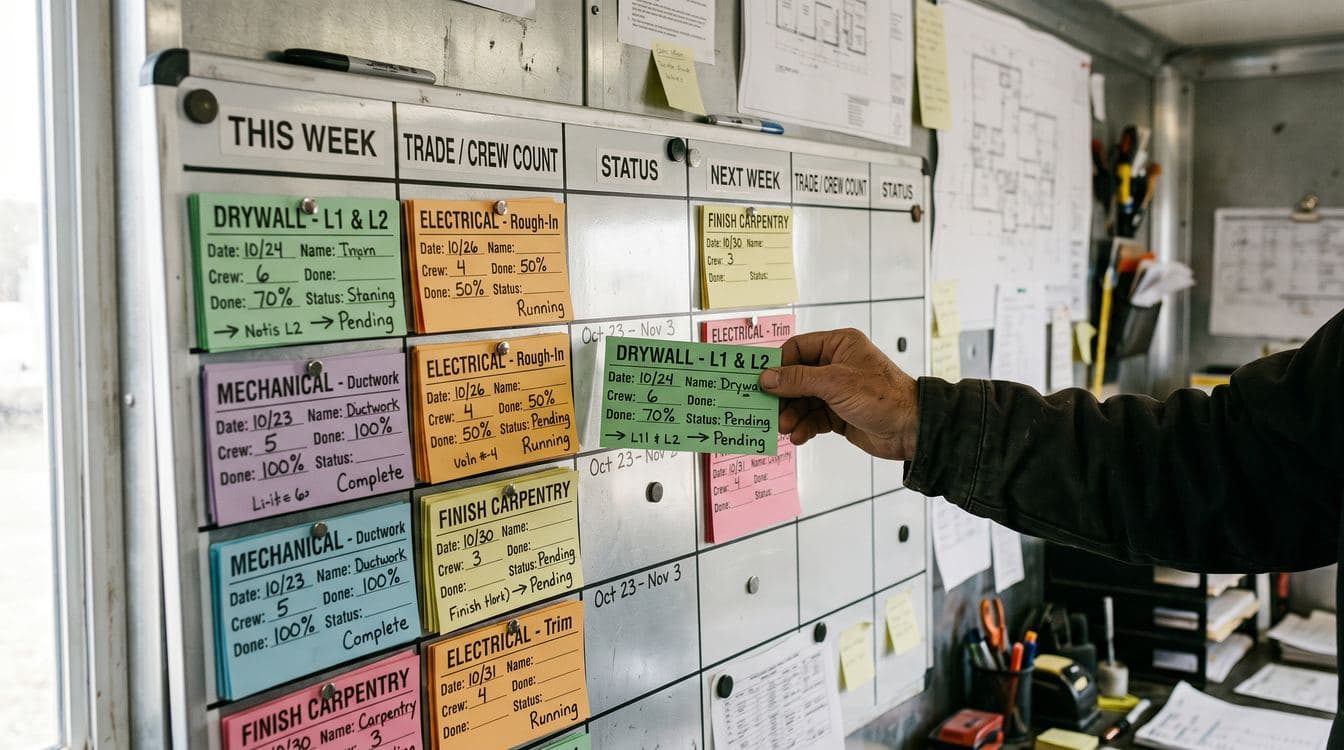
Most GCs we audit have a prequal form. Few have a prequal process. The form gets emailed to a new sub, returns 11 days later, the PM glances at the COI and bonding line, and the sub goes on the approved list. Nine months later that sub is on three of your jobs and you discover their EMR is 1.42 and they have lost two key supervisors.
The Associated General Contractors of America publishes standard prequal questionnaires mid-market GCs adapt. A working version covers six sections: financial capacity, safety performance (EMR, OSHA recordable rate, last three years), past performance with named GC references, current workload as a percentage of capacity, key personnel changes in the last 12 months, and technology stack alignment. The last matters more than people think. A sub who refuses to use your shared documentation thread will produce coordination cost regardless of field skill.
A prequal process, distinct from a form, looks like this:
- Form returns within 14 days or the sub drops out.
- Two reference calls minimum, with named superintendents, not estimators.
- A site visit to the sub's current job. Twenty minutes, no notice.
- A go/no-go meeting with the PM, superintendent, and a financial signer.
- Approved subs receive a scope-of-work template that names coordination expectations: daily report cadence, RFI response window, pull planning attendance, and documentation thread participation.
We covered the related problem of capturing what a sub's key supervisor knows before they leave in Capture Tribal Knowledge Before Key People Leave.
The output of a real prequal is a smaller approved sub list, usually 30% to 40% smaller than the GC started with. That sounds bad. It is not. Your top quartile of subs produces 70% of on-time completions. The bottom quartile produces 80% of your coordination cost.
Fix Two: Weekly Pull Planning by Trade Sequence
The Last Planner System has been around since the early 1990s. Pull planning, its scheduling component, is the single highest-leverage coordination tool we have seen at mid-market GCs, and the most consistently underused.
Procore's guide to pull planning covers the mechanics. The operator version: a weekly pull planning meeting runs 45 to 90 minutes per active job, held the same day each week, attended by your superintendent plus a named foreman from each trade scheduled in the next six weeks. The meeting works backward from a milestone (rough-in complete, drywall ready, certificate of occupancy) and lays sticky notes in reverse sequence. Each note is owned by a named foreman, not a company, with a duration estimate the foreman commits to in front of the other trades.
The discipline is the commitment. When a framer commits to nine days in front of the plumber, electrician, and HVAC foreman, that commitment carries weight an email date does not. When the framer slips, the slip is visible, and downstream trades reschedule themselves rather than the PM doing it for them.
For a GC running 15 jobs, weekly pull planning costs 15 to 20 hours of superintendent time per week. Measured on three engagements: hours saved by eliminating sub-showed-up-and-couldn't-work events, re-sequencing trades, and answering scheduling RFIs by phone runs three to four times the meeting cost. Net: 30 to 40 hours recovered per week, the slack that lets one super run 20 jobs instead of 10.
Tools matter less than people think. We have seen pull planning run on physical walls, Smartsheet, FieldWire, Miro, and inside Procore. The two failure modes: the meeting becomes a status read-out, or the same person tries to attend every session and burns out by month three. Fix: rotating ownership and a written meeting structure.
If you are also struggling with the dispatch layer of your operation (technicians, not subs), the same pattern applies and we wrote it up in Field Service Scheduling Breaks Past 25 Technicians.
Fix Three: One Documentation Thread Per Job
This is the change owners resist and that pays back the fastest.
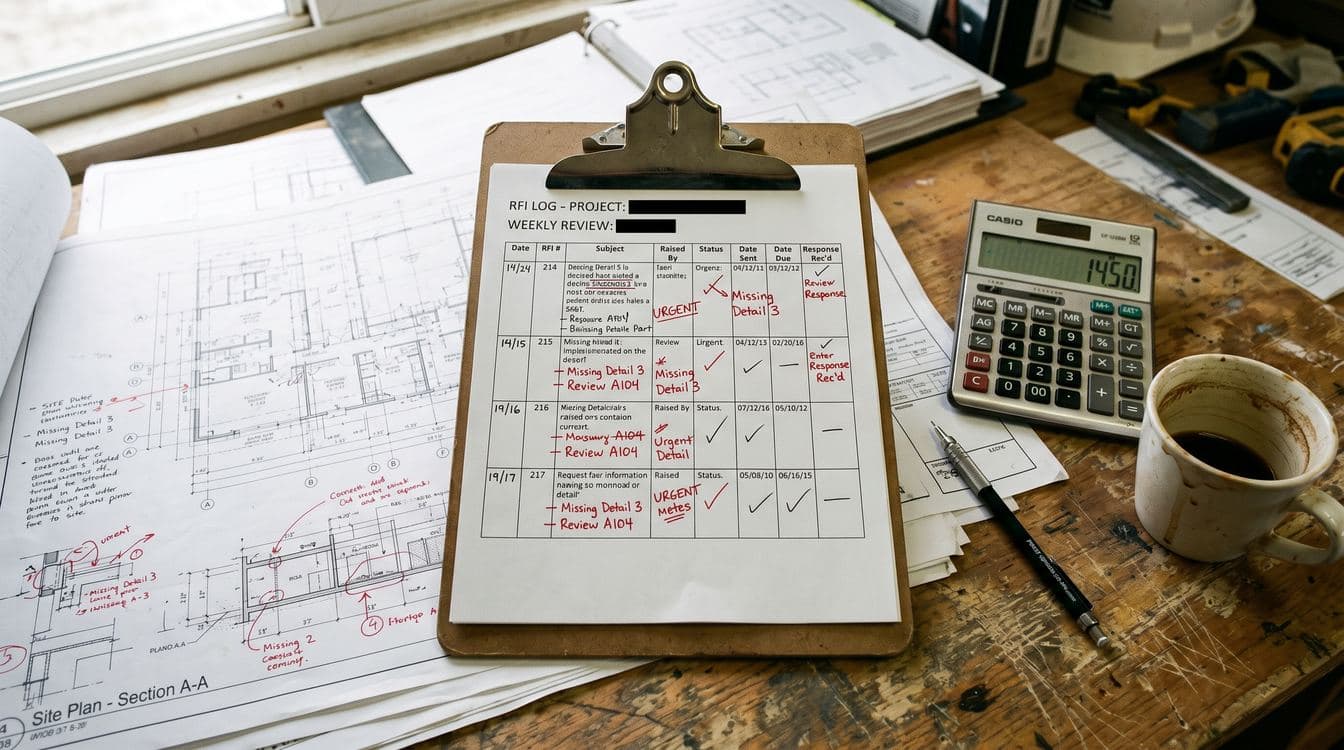
The pattern at 15-job GCs is documentation sprawl. RFIs live in three places: Procore on jobs A-F, Buildertrend on jobs G-K, and an email thread on jobs L-O because the owner refused to switch. Change orders live in QuickBooks for billing, Smartsheet for tracking, and a SharePoint folder for client signatures. Field photos live on the super's iPhone, his foreman's iPhone, and a Dropbox folder unorganized since 2022.
The single-thread rule: every job has exactly one documentation thread that lives in exactly one tool. RFIs, change orders, daily reports, field photos, and approval signatures all land there. The PM owns enforcement. Subs who do not participate are out of compliance with their contract, the same way they would be without a COI.
Buildern's overview of subcontractor portals describes the technical version, and most mid-market PM platforms (Procore, Buildertrend, FieldWire) offer equivalent functionality. The decision is less about which platform than about which one your subs will adopt. We covered the tradeoffs in Procore vs. The Field: What Contractors Need.
The duplicated change order problem alone is worth this fix. We have audited GCs running parallel CO logs and found 6% to 9% of change orders either double-billed, missed, or billed wrong. On a $40M revenue base, that is $2.4M to $3.6M moving incorrectly inside billing. According to data summarized by Buildern and FMI research, change orders average 10% of total contract value, with some projects at 25%. Getting the documentation thread right turns that 10% from a leak into a tracked, billable line.
The upstream version of the same documentation discipline shows up in Why Your Quoting Process Is Costing You Jobs.
The Workforce Reality Behind All Three Fixes
The reason this matters now, not in 2019, is the labor environment. Associated Builders and Contractors reported in January 2026 that construction needs 349,000 net new workers in 2026, rising to 456,000 in 2027. The retirement curve is steeper than the apprenticeship pipeline, and 28% of construction firms reported ICE-related workforce disruptions in the prior six months.
What that means for your coordination problem: the sub crews you depend on are smaller, more turnover-prone, and less likely to absorb the cost of your inefficient coordination. In 2019, your best framing sub would eat a wasted half day when slab inspection ran late. In 2026, that sub bills the half day and moves the crew to the next GC's job by lunchtime, and there is no second framer to backfill. The cost of coordination failure has gone up because labor market slack has gone down.
What This Costs, And What It Costs Not To Fix
For a GC running 15 jobs averaging $2M in contract value, the unmanaged coordination cost we have measured runs $180K-$340K in superintendent time, $90K-$200K in rework from missed sequences, and $150K-$400K in change order leakage. Total: $420K-$940K. Real margin, on a business netting 4% to 8% before coordination cost.
The fix costs less than expected. Prequal redesign is 60 hours over a quarter. Pull planning ramp-up is 90 days of meeting discipline. Single-thread documentation is a contract change and a 30-day enforcement push. Platform cost stays flat.
The piece harder to quantify, and that matters more, is optionality. A GC at 10 jobs running an informal system has no path to 20 without burning out the super or hiring a second. A GC at 10 jobs running the three-part system can take the next five without adding leadership headcount. That growth lane is worth more than the coordination savings.
FAQ
Why does coordination break around 15 jobs instead of some other number?
The threshold floats between 12 and 18 depending on job size, but the mechanism is consistent. One superintendent layer reliably coordinates 30 to 35 active trade fronts. At 15 jobs averaging four trades, you cross 60 fronts and exceed the cognitive limit of one super.
Do I need to buy Procore or Buildertrend before I can fix this?
No. We have seen this work on Smartsheet and a shared OneDrive folder. The tool matters less than the discipline. If you have no PM platform, pick the cheapest one your subs will adopt. If you have one, do not switch mid-overhaul.
How long does the full rollout take?
Ninety days for prequal, 90 days for pull planning to become habit, 30 days for documentation thread enforcement. Run them in parallel. Expect month two to feel worse than month one because the new processes surface problems the old system hid.
What if my subs refuse to attend weekly pull planning?
That is a prequal signal. A sub who will not attend a 60-minute weekly meeting in exchange for visibility into upcoming work is not aligned with your operation. Write attendance into the contract. Half your subs will adapt; the other half will self-select out.
Where We Come In
Granular builds custom AI and operations systems for mid-market firms, including GCs who have hit the 15-job wall. If you are running 10 to 25 active jobs and can feel coordination cost in your margin but cannot quite price it, a 30-minute discovery call is the cheapest test of whether the three-part fix is your starting point. Reach out through the homepage or our Tampa office.
Keep Reading
- Field Service Scheduling Breaks Past 25 Technicians: The dispatch-layer equivalent of the 15-job wall, with the same mechanical thresholds and a different fix.
- Why Your Quoting Process Is Costing You Jobs: The upstream version of documentation discipline, focused on how quoting handoffs leak margin before a job even starts.