Why Mid-Market Manufacturers Still Print Travelers
Paper travelers persist on shop floors after every digital rollout. The reason is not Luddism. The paper is doing six jobs your MES probably does three of.
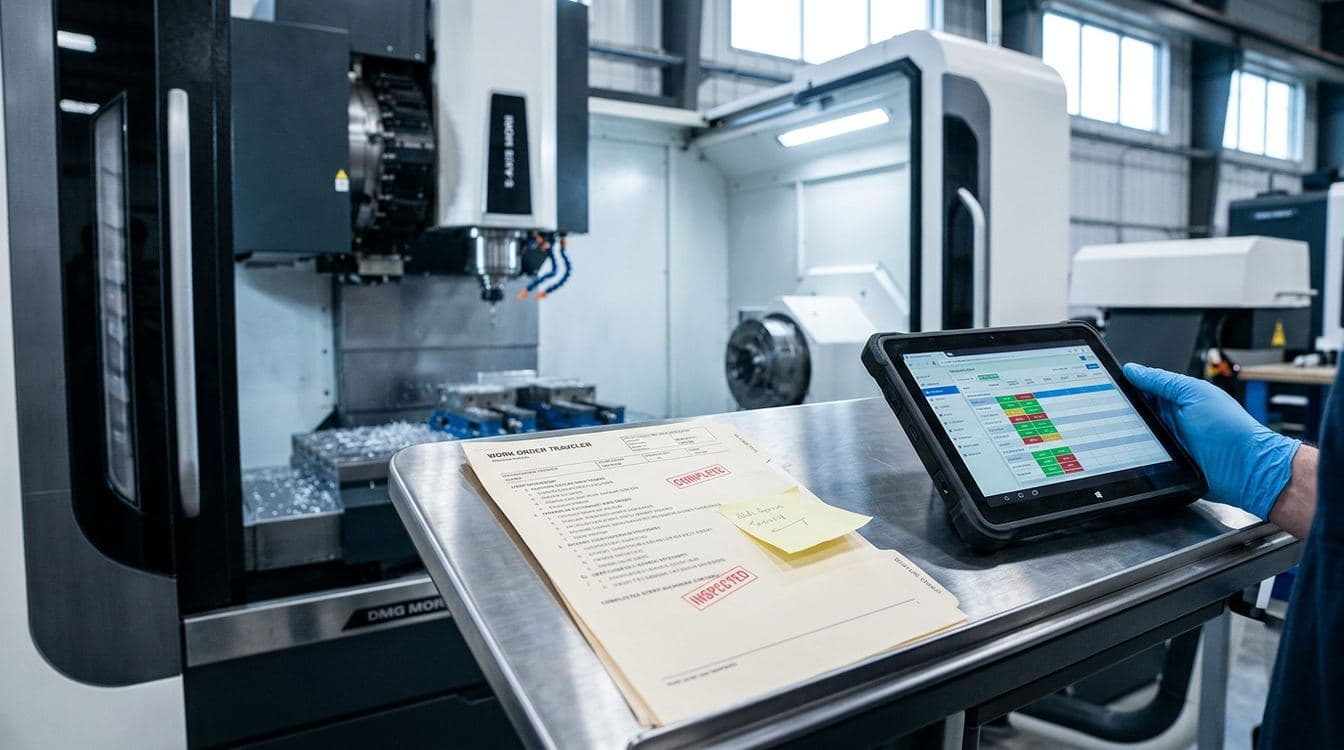
TL;DR. Paper travelers persist on mid-market shop floors after every paperless initiative because they do six jobs at once: revision record, kanban signal, inspection sign-off, outage backup, operator-notes margin, and audit artifact. Most MES products do three of those well at the workstation. Before you buy MES, map the six jobs your traveler is doing today. If your MES candidate cannot do all six, the paper will come back inside six months. Plan for that.
It is Tuesday morning at a $45M precision machining shop in southeast Michigan. The dispatch desk holds a stack of about forty manila packets, each clipped to a printed router. The MES screen behind the desk also shows the same forty jobs. The two views do not agree. One operator pulls a packet, scans the barcode, and walks it to the milling cell. He writes a yellow sticky note on the cover: "watch chip break op 30." That note will not exist anywhere else by lunchtime.
This is not a story about a shop that has not figured out digital. This shop runs Epicor, ProShop, or Plex (pick one, the answer is the same). It has barcoded carts and tablets at every workstation. The shop floor manager is forty-three, not seventy, and reads Hacker News on the weekend. Paper is still everywhere. The question is not why these shops resist going digital. The question is what the paper is actually doing.
The Paper Is Doing Six Jobs
When operators describe their travelers, the document does a lot of work that gets compressed into one word. Pulled apart, the packet is doing six jobs simultaneously.
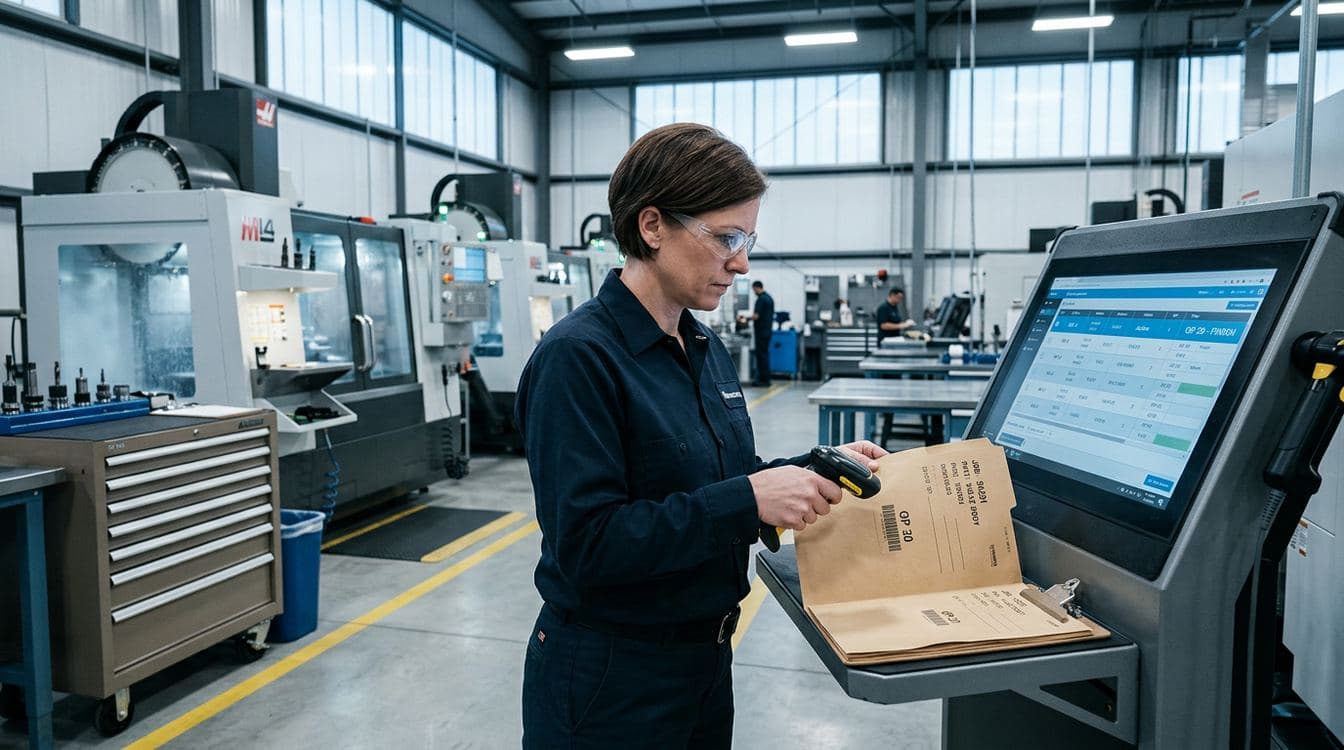
-
Revision record. The paper has the engineering rev stamped on it. Operators are trained to read that stamp and trust it. AS9100 and ISO 9001 both require the current revision to be available at the point of use. The standard does not require paper. It requires that the document at the workstation matches the released drawing. Paper is the lowest-friction way to satisfy that requirement.
-
Kanban signal. The packet itself is the work-in-process indicator. An empty bin with a packet on top means pull. Full bin with no packet means done. The traveler is doing the job that, in a different shop, an Andon light or a wall screen would do. Operators do not have to look up at a monitor. The packet is right there with the parts.
-
Inspection sign-off. Quality stamps a wet-ink stamp on the operation step. A signature. Initials in a box. Auditors want to see that ink. For aerospace and medical primes, the signed paper often becomes the device history record or the batch record artifact. The traveler is the audit handoff.
-
Outage backup. When the ERP or MES goes down (and yours will go down a few times a year), the printed traveler is the only thing still tracking the part. Production does not stop because the network is slow. Operators have seen this. They keep printing.
-
Notes margin. "Watch chip break op 30." "Run with new tool, old one chattered." "Customer specs allow 0.005 oversize." These notes are tribal knowledge that the field structure in the MES does not have a place for. Or has a place for, but the place takes eight clicks and a login that timed out. Operators write on the paper because writing on the paper takes one second.
-
Physical handoff. The packet moves with the part. From milling to grinding to inspection to shipping. The packet IS the handoff. Picking up the packet means "this is yours now." Operators do not need a status meeting to know what to work on. The packet on their bench is the entire work assignment.
The persistence of paper is not a cultural failure. It is a workflow that has evolved to do six things at once. Most MES products do three of them well at the workstation and assume the rest will be solved with training. They are usually not.
Why Paperless Rollouts Come Back to Paper
Modern Machine Shop has a phrase that has been kicking around shop-floor publications for years: "There is nothing more common in machine shops than a job traveler. There is also nothing so rare as one that is up-to-date."
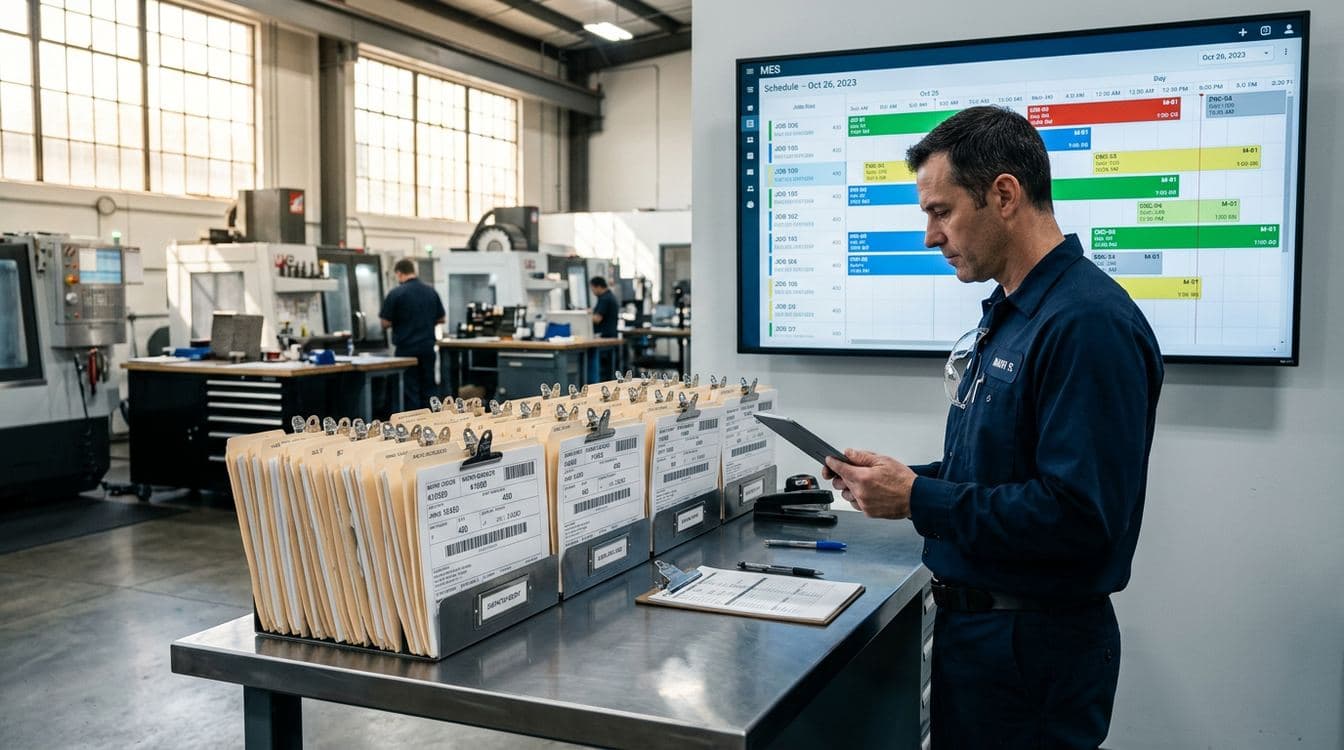
The shops that go fully paperless and stay paperless are a small minority. Most paperless initiatives at mid-market manufacturers run for four to six months and then start quietly printing again. The reasons are predictable.
The workstation tablets get coolant on them. Or the operators are in gloves. Or the screen has glare at 6:30am when the sun comes through the bay door. The interface friction makes a tablet a worse data-entry surface than a piece of paper.
The MES does not have a notes field at the operation level, or it does and it requires three taps and a confirm. The yellow sticky note appears on the traveler again.
The ERP goes down for ninety minutes on a Wednesday. The shop manager prints travelers as a backup so the line does not stop. After that incident, the shop manager prints them every Wednesday, then every day.
Quality finds an audit-trail gap and asks for the signed copy. The signed copy is paper. Quality starts requiring a printed traveler with stamps. Engineering gives in. Paper is back.
The data behind this is worth a number. According to recent industry surveys including the SME and CESMII Smart Manufacturing Survey, roughly two-thirds of mid-sized manufacturers are implementing smart-manufacturing strategies, but only about 40% have dedicated staff to make them stick. For mid-market specifically, MES adoption sits closer to half of plants, compared to over 70% at large enterprises. For the half of mid-market that does not yet have MES, the paper traveler is the only system tracking what is on the floor. For the half that does have MES, the paper still survives because the digital system is not doing all six jobs at the workstation. The same gaps that drive work-in-process visibility problems show up here too.
What the Gap Actually Costs
If the paper-to-digital seam works, the cost of paper is low. Pennies of toner. If the seam does not work, the cost is large and quiet.
A few benchmarks worth knowing.
Manual data entry from paper to MES runs a 1 to 3% error rate. On a shop running fifty operations per day, that is one to two wrong entries per day, every day. Compounded across a month, that is the source of most of the variance between what the MES says is on the floor and what is actually on the floor.
Roughly 80% of inventory discrepancies trace to human data entry, and average inventory accuracy at mid-market manufacturers sits around 83%. World-class is 95% or higher. The gap is partly a paper-to-digital reconciliation problem.
Adrian Wagner of Amtex, quoted in The Fabricator, said his production manager spent four hours a week reprinting traveler paperwork that got lost on the shop floor. That is one full week per quarter of management time, gone before anyone has scheduled a job.
The information lag between a physical shop floor event and ERP visibility under a paper traveler workflow is typically 24 to 48 hours. By the time the ERP sees what happened on Monday morning, the cell has moved on to Wednesday's job. Cost estimating, customer promise dates, and material reorder triggers all run on data that is two days behind reality.
None of these are catastrophic on their own. Together they are the slow leak in a $45M shop's margin.
The Question to Ask Before You Buy MES
Most MES sales pitches are about how the system will replace paper. That is the wrong question. The right question is whether the MES does all six jobs the paper traveler is doing today.
A fast diagnostic. Walk your shop floor. Pick five workstations at random. For each one, ask the operator three things.
Show me what is written on the traveler that is not in the MES. What do you do when the MES goes down? Where does quality sign off on this operation?
If the answers reveal that the traveler is doing work the MES does not do, plan for that gap when you scope your MES rollout. Either pick a system that handles all six jobs at the workstation, or accept that paper will survive in a supporting role and design the seam between the paper and the MES so it is not a source of errors. Both are valid answers. Pretending the seam does not exist is what kills paperless rollouts.
FAQ
Are paper travelers actually required for AS9100 or ISO 9001 compliance? No. The standards require that the current revision is available at the point of use, that obsolete versions are kept out of normal use, and that approval and sign-off methods are documented. Paper is the lowest-friction way to meet those requirements, but a properly configured MES with revision control and locked-down operator workstations is also compliant. The IAQG publishes guidance confirming this.
What MES platforms are mid-market shops actually buying? The most common picks in the $30M to $100M range are Epicor Kinetic with Advanced MES, JobBOSS2 from ECI, Plex from Rockwell, Global Shop Solutions, and ProShop ERP for AS9100 job shops. Tulip is increasingly popular when shops want to build their own workstation apps. The right choice is shop-specific and depends on production mode (job shop, batch, repetitive) and the existing ERP.
How long does a typical mid-market MES deployment take? Plan for six to twelve months from contract to production go-live. The implementation itself is three to six months. The change management and floor adoption is the rest. Shops that try to compress this timeline are the shops that print travelers again at month nine.
Is there a hybrid approach where paper and MES both work? Yes. The shops that get this right design the paper to be a deliberate artifact rather than a workaround. The MES is the source of truth for status and revision. The paper exists for sign-offs, audit handoff, and outage resilience. The seam between them is documented and reconciled daily, not weekly. That hybrid model is more common than fully paperless in mid-market manufacturing.
Can a smaller shop skip MES entirely and just run on travelers? Below $20M or so in revenue, that often makes sense. Above $30M, the cost of reconciling paper to whatever runs your job costing and scheduling starts to exceed the cost of MES. The exact tipping point depends on production complexity, customer compliance demands, and how many people the shop wants to hire just to maintain the spreadsheets that bridge the gap.
What This Means If You Are Scoping MES
The paper traveler is not dumb. It is a working solution that does six jobs at once. Before you replace it, know which of those six jobs your MES candidate actually handles at the workstation, and which ones it leaves on the floor manager's desk to figure out. Granular has spent the last year building shop-floor tools for $40M to $80M manufacturers and the patterns are consistent. We can walk your shop, map the six jobs your traveler is doing today, and tell you which off-the-shelf MES will hold and which will quietly fail in six months. If that sounds like the conversation you need before you sign a contract, book 30 minutes with us.
Keep Reading
- Work-in-Process Visibility for $40M Manufacturers. How mid-market manufacturers get real-time visibility into what is on the floor without ripping out their ERP.
- Why Your Shop Floor Knows Things Your ERP Doesn't. The tribal knowledge that lives in the heads of senior operators, and how to capture it before it walks out the door.