The Mid-Market Electrical Contractor's Data Center Playbook
Data center MEP is now 75% of the GMP, and electrical is the centerpiece. Here is how $50M electrical contractors actually win the work.
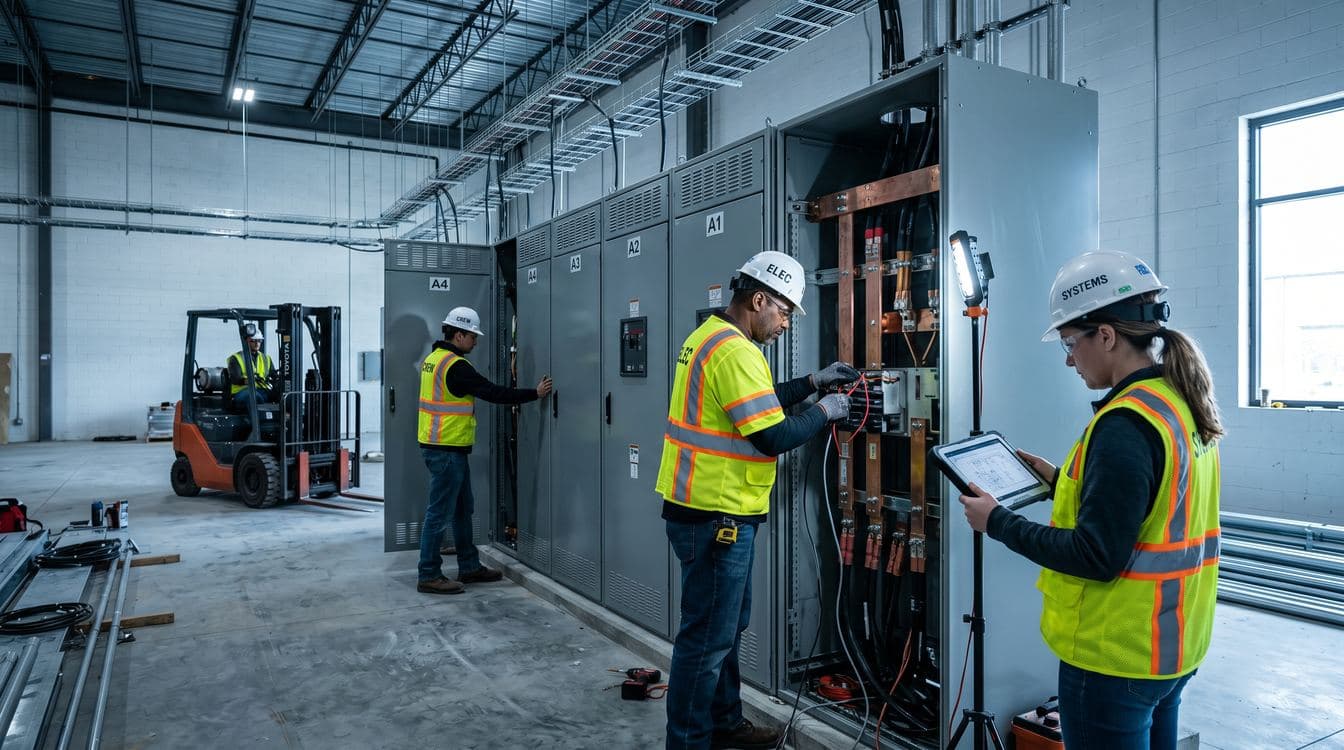
TL;DR. Electrical scope now runs 32 to 38 percent of the GMP on AI-focused data center bids, which means the electrical contractor is no longer a side scope. Mid-market firms that want this work have to operate like manufacturers, not contractors: switchgear ordered before design freeze, prefab above 60 percent, BIM-coordinated assemblies, and a labor plan locked 12 to 18 months out. The mid-market electrical contractors winning this work are not the cheapest. They are the ones who treat procurement, prefab, and commissioning as one connected workflow.
The math has shifted. On an AI-focused data center bid in 2026, electrical scope is 32 to 38 percent of the guaranteed maximum price, and the full MEP package runs around 75 percent of the GMP. You are not bidding a side scope. You are bidding the centerpiece. If you run a $50M to $100M specialty electrical contractor and you want this work, the operational playbook is different from anything you have run on commercial or industrial jobs.
Why $50M Electrical Contractors Are Getting Squeezed
The data center construction market hit $32 billion in 2025 and is tracking toward $35 billion in 2026, with the money concentrating in the hands of contractors who have already earned the trust of hyperscalers. Microsoft, Amazon, Google, Meta, and the growing list of AI companies building their own compute infrastructure are not interviewing new electrical contractors every month. They are repeating with the firms who delivered the last build clean.
The squeeze for mid-market firms is real. MEP contractors above $250M in revenue are growing at 14.5 percent per year, roughly triple the industry median, while mid-market players run flat. The gap is not size. It is process. The $250M-plus firms operate like manufacturers: standardized assemblies across projects, repeatable detailing standards, BIM-to-fabrication-to-field workflows, and central planning that schedules crews like production lines.
For a $50M electrical contractor, this means owners increasingly want one MEP point of contact, the ability to self-perform 70 percent or more of the work, proven prefabrication capability, and early VDC engagement. Standalone single-trade firms without those capabilities get relegated to labor-only roles where the margin is thinnest.
Switchgear Lead Times Run the Job Now
Procurement used to be a parallel activity. On data center work, it is the first phase of construction.
Medium-voltage switchgear lead times sit at 45 to 80 weeks per Wood Mackenzie's Q2 2025 supply chain survey, and substation transformers stretch to 18 to 24 months. Some bespoke transformer orders are quoted at four years. These are not supply chain disruptions. They are the new baseline as US data center capacity scales from roughly 24 GW today toward 100 GW by 2030.
Design freeze now sits three to five months earlier than most teams are used to running it. Any change after freeze triggers a procurement cascade that adds 6 to 10 weeks to the critical path. The contractors hitting 16-to-20-month delivery targets are the ones holding design freeze discipline, not the ones pouring concrete fastest.
Three operational shifts you have to make:
- Reserve factory slots before design completion. Lock the slot first, fit the design to the available equipment second. If you wait for a frozen design to order transformers and switchgear, you slip months.
- Treat HV kit as a programme item, not a procurement item. It runs on its own track with its own milestones, owned by a procurement lead, not a project manager juggling 14 other things.
- Build a submittal calendar that runs backwards from the energization date. Miss a submittal approval window and you do not just lose a week on site. You lose the factory slot that sets your entire sequence.
The financial exposure when you miss is asymmetric. A 60MW colo running at $0.24/kWh and 85 percent utilization generates roughly $14.2 million in monthly revenue. That revenue clock is tied to energization and integrated systems testing sign-off. Liquidated damages and availability credits can hit the contractor directly. Every week of slip has a number you need to price into your risk register before you sign the GMP.
Owner-Furnished Equipment Changes the Commercial Model
If you have done industrial work, you are used to making margin on equipment. Hyperscale data center work breaks that model.
On hyperscale jobs, owners often buy the major electrical and mechanical kit directly and issue it to the project as free-issue. That is owner-furnished equipment. It strips your equipment margin and shifts your exposure into labor productivity, coordination quality, install workmanship, and clean commissioning evidence.
This means two owner models now drive how you make or lose margin:
Hyperscaler model. Repeated tight kit of parts. Hard design freeze. Owner-furnished major equipment. Tight turnover gates. Predictable, but lower equipment margin. You make money on labor productivity and clean commissioning. You lose money on rework, change orders, and integrated testing delays.
AI-native owner model. Denser compute. Faster schedules. More unknowns pushed into the MEP package. Often more procurement scope in the contractor's bid. Higher equipment margin opportunity but materially more design and commissioning risk.
You cannot bid both with the same prelims, procurement plan, or commissioning allowance. The mid-market firms losing money on this work are the ones running a single bid template across both owner types.
Prefabrication Above 60 Percent or You Cannot Compete
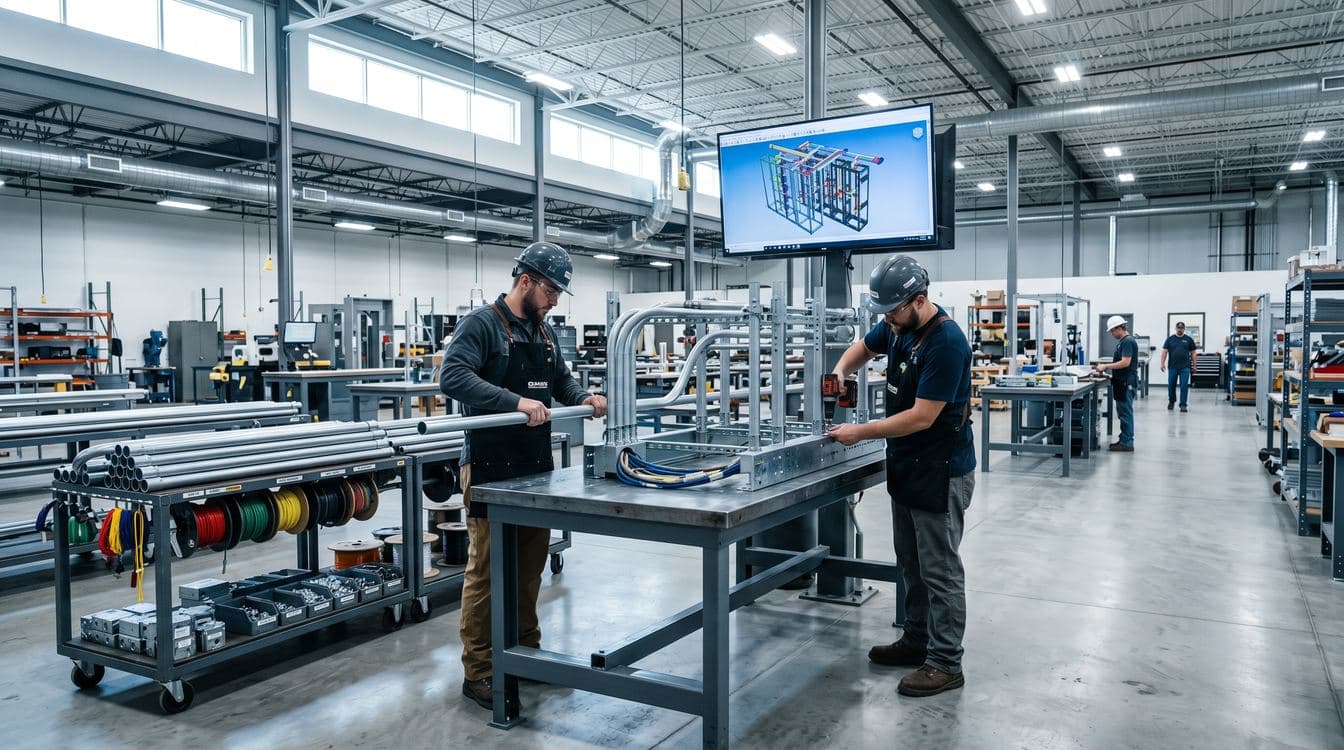
The average MEP contractor prefabricates less than 30 percent of total work, per the 2025 State of MEP Report. Firms with prefab rates above 60 percent grow at 14.5 percent regardless of headcount. On data center work, the leading GCs are pushing further: Mortenson published a 2024 colocation case study where 70 percent of MEP fit-out was done off-site, and DPR Construction delivered a 980,000-square-foot, 200MW Phase 1 in under 18 months using prefab partnerships that installed 600 prefinished wall panels in seven days.
What that looks like operationally for a $50M electrical contractor:
- Conduit racks built in the shop, not field-bent on site. Six-rack assemblies pre-terminated, pre-labeled, dropped into place.
- Panel sub-assemblies delivered as factory-tested skids with wire harnesses pre-pulled to a coordinated BIM model.
- Modular electrical rooms that arrive on a flatbed, get craned into place, and require only feeder terminations on site.
- Cable tray sections spool-fabricated from BIM-coordinated drawings, delivered cut-to-length with hangers attached.
Schneider Electric and Vertiv case studies put the field labor reduction from this kind of prefabrication at 20 to 40 percent. On a project where electrical labor is the constraint, that is the difference between holding schedule and triggering liquidated damages.
There is a sequencing trap. Prefab buys you field time, but it makes long-lead slippage more expensive. A two-week delay on a switchgear lineup does not cost two weeks on the commissioning program. It costs four to six, because the integrated testing sequence restarts from the delayed milestone. Modular assemblies arrive pre-tested to factory standards, but integrated systems commissioning (cooling controls talking to power management, both talking to the BMS) cannot be prefabricated. That sequencing still runs on site, in order, and it compresses badly when upstream packages are late.
The BIM and Coordination Layer Is Not Optional
For data center work, BIM is contractually required, not a nice-to-have. The deliverables an owner expects from a mid-market electrical contractor on this work:
- A coordinated 3D electrical Revit model with all routing decisions, equipment locations, and clearance requirements
- Spool-level prefabrication drawings derived from the coordinated model
- Clash detection reports with documented conflict resolution
- Field-ready shop drawings at a level suitable for foreman and crew use
- As-built modeling support for owner turnover
The mid-market electrical contractors winning this work either have a VDC team in-house or have a tight partnership with a BIM service provider that can hold a federated coordination meeting weekly without disrupting the field schedule. If your current workflow is "we draw it in 2D and hope clash detection happens in the GC's coordination meeting," you are bidding the wrong jobs.

The Labor Math Is Brutal
The data center construction industry faces a projected 499,000-worker shortfall in 2026 per Associated Builders and Contractors, with 349,000 additional construction workers needed this year alone. Roughly 20,000 union electricians retire annually, while 300,000 new electricians are needed to meet AI-driven data center demand over the next decade.
The numbers in the field tell the same story. A journeyman electrician now earns roughly $59.50 an hour on union scale, with foreman and overtime hours pushing closer to $200,000 a year per Fortune's 2026 reporting on electrician compensation. In data center hot spots like Northern Virginia, Arizona, Ohio, and the Southeast, contractors are paying $20,000 to $40,000 relocation premiums to pull experienced workers in from out of market.
If you are running a $50M electrical contractor and you want sustained data center revenue, you cannot staff this work on the spot market. The math you have to run:
- Lock crews 12 to 18 months forward. MEP leaders, commissioning specialists, and project managers on the best jobs are committed that far out. If you are recruiting at award, you are recruiting too late.
- Expand your apprenticeship pipeline now. NECA reports commercial apprenticeship applications jumped from 70,000 in 2022 to 120,000 in 2024, but slots have not kept up. The contractors growing fastest are the ones partnering with their local IBEW or IEC chapter to expand sponsored slots and absorbing more apprentices than the historic ratio.
- Build internal foreman development. The crew leader who can run a clean 60MW commissioning sequence is the constraint. You cannot hire one mid-project at any price. You have to grow them.
Where Tooling Actually Helps
There is no tool that fixes a 78-week switchgear lead time. There is no software that recruits electricians. The places tooling moves the needle on this kind of work:
- Submittal and procurement tracking that ties each long-lead item to its factory slot, submittal due date, and downstream sequence dependency, so the procurement lead is not living in 14 spreadsheets
- Field productivity dashboards that compare planned versus actual install hours by assembly type, so foremen can spot a productivity miss in week two of a 20-week pour, not in week 18 when the LDs hit
- BIM-to-fabrication-to-field workflows that push spool drawings, install sequences, and as-built capture through the same model, instead of three disconnected tools
- Commissioning evidence capture that produces the clean turnover binder owners require without three weeks of paperwork at the end
This is operational tooling work that 24- and 36-month enterprise software implementations do not solve. It is workflow work, built around the specific data your operation already generates, ranked by which decisions are getting made too late.
What This Means for the Bid Decision
Mid-market electrical contractors should bid data center work when they can credibly answer yes to all of these:
- Can we hit prefab above 60 percent on this scope?
- Do we have or can we partner for a coordinated BIM workflow?
- Can we lock a foreman, a procurement lead, and a commissioning lead for the duration before we sign the GMP?
- Have we modeled the owner type (hyperscaler with OFE vs AI-native with full procurement scope) and priced accordingly?
- Have we run the liquidated damages math on a two-week slip and priced contingency for it?
If three of those are no, the work will lose money and damage the relationship for the next bid. If four or five are yes, you can compete with firms three times your size.
The mid-market electrical contractor with a $5M switchgear procurement going to a four-person shared inbox is not going to win this work. The one with a procurement lead who owns the long-lead schedule, a foreman locked 12 months in advance, and a prefab shop running at 60 percent of scope has a real shot at the next bid that comes through.
Where Granular Comes In
Granular builds AI agents and focused tools for mid-market contractors getting into work that runs on tighter margins and tighter coordination than they are used to. Fixed price, four weeks, working tool. If you run a $50M to $100M electrical contractor looking at data center MEP work and you need to stand up the procurement, prefab, and commissioning workflows before your next bid, book 30 minutes with us. We will tell you straight what is worth building, what to buy, and what to leave alone.
Keep Reading
- What Hyperscaler Capex Means for Mid-Market MEP. The macro context behind the data center buildout opportunity and where the capital is actually flowing.
- Why Sub-Contractor Coordination Breaks at 15 Active Jobs. The coordination workflow that fails when you scale into the kind of multi-trade work data center buildouts demand.