How $50M HVAC Contractors Hit 78% Tech Utilization
The industry average is 65% billable. The top quartile clears 78%. The gap is 250 hours per tech per year, and it lives in your dispatch board.
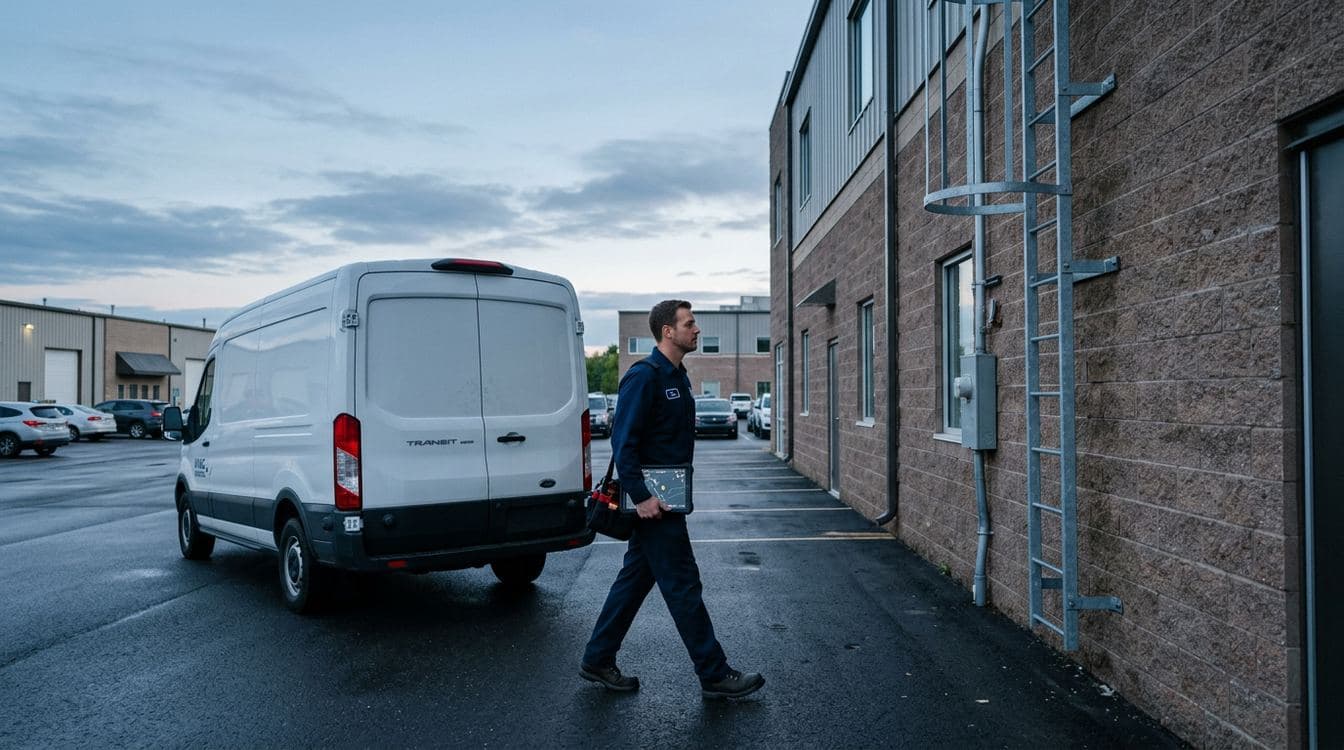
TL;DR. The HVAC industry average for technician utilization is 65%. The top-quartile threshold is 78%. A 30-tech service operation closing that gap recovers roughly 7,500 billable hours per year, worth more than $1.1 million at a $150 bill rate, without hiring a single new technician. The four levers that actually move the number are dispatch geography, standardized truck stock, shift boundaries that start at the curb, and 5% emergency capacity built into the daily schedule.
A $50M HVAC contractor with 30 service techs running at 65% utilization is leaving roughly $1.1 million on the table every year. That is the gap between the industry average and the top quartile, and closing it does not take a hiring spree or a new dispatch platform. It takes four operational changes most service managers know they should make but have never had the air cover to enforce: cluster jobs by geography, standardize what is on every truck, end the shop bottleneck on both ends of the shift, and stop overbooking your day.
What "tech utilization" actually measures
Tech utilization is one number with one formula: billable hours divided by total paid hours, expressed as a percentage. If your tech is on payroll for 45 hours and you billed 30 of those hours to customers this week, your utilization is 67%.
The benchmarks worth pinning to the wall:
- Industry average: 65% billable, or 5.7 of every 8.8 paid hours, per a Field Promax study in ACHR News (10,000+ data points across 300 HVAC companies).
- Top-quartile threshold: 78%, per Fieldproxy's 2025 HVAC Benchmarks (2,000+ field service companies).
- Healthy operating range: 70-85%, per FieldEdge's 2026 utilization benchmark guide.
Why this matters more than five years ago: the labor math has stopped working. Per Level CFO's June 2026 analysis, HVAC is short roughly 110,000 technicians, with a meaningful share of the current workforce within five years of retirement. You cannot hire your way to the next revenue tier. The only lever that still scales is yield per technician you already employ.
For a $50M operator with 30 service techs at 45 paid hours per week and a $150 blended bill rate, moving from 65% to 78% is worth roughly $37,500 per tech per year, or $1.13M across the service group. Recoverable revenue with zero incremental payroll.
The unbilled hours go to five predictable places: drive time between jobs, shop time at the start and end of shift, parts runs mid-day, paperwork and admin, and idle gaps when the schedule does not refill after a cancellation.

The four levers that move the number
If your shop is at 65% and you want to be at 78%, you need to find 13 percentage points of unbilled time and convert them. On a 45-hour paid week, that is 5.85 hours per tech per week, or roughly 250 hours per tech per year. When you walk a service operation looking for those hours, they cluster in four places. Each one has a fix.
Lever 1: Geographic clustering at booking, not at dispatch
Most HVAC dispatch teams treat routing as a problem to solve at 6 AM on the day of service. By then it is too late. Today's jobs were booked over three weeks by a CSR who took them in the order the phone rang.
The fix is to push geographic constraints upstream into the booking workflow. When a customer calls, the booking system should already know which neighborhoods are loaded for which days and which time windows fit the nearest tech. The simple version is manual zone-and-day rules ("North side service: Tuesdays and Thursdays before 3pm"). The sophisticated version uses density-based clustering algorithms that score each new booking for geographic fit and recommend time slots accordingly.
Either approach drives the same outcome. Route optimization studies across HVAC fleets show drive time reductions of 30-40% and 2-3 additional completed jobs per tech per day when geography is enforced at booking. For a 30-tech operation, that is 60-90 incremental service calls per day on the same payroll.
The hard rule that backs this up: cap drive time between any two consecutive appointments at 30 minutes. If your dispatch system cannot enforce that, your dispatch system is the bottleneck.
Lever 2: Standardized truck stock
The Field Promax study has one observation that should make every service manager pause: "Missing a common part wrecks two routes, not one." The tech who hits the parts house at 11 AM is gone from the route for 45 minutes, and the tech covering his next appointment is now late and has to swap something.
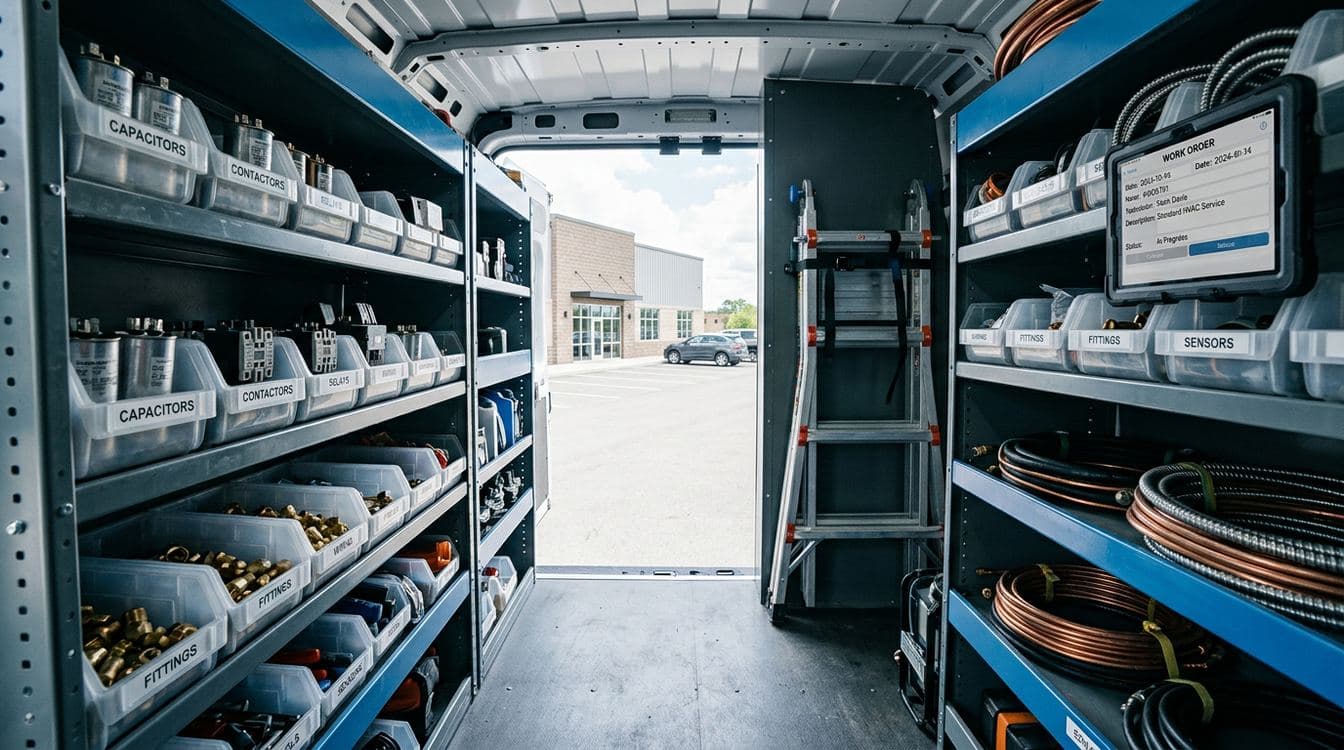
Standardized truck stock means every service truck carries the same controlled parts list, sized to handle at least 80% of the service call types you actually run. The list is built from your last 12 months of work order data, not from what the parts manager thinks the truck needs. You restock weekly against a printed checklist, not on demand when the tech notices something is missing.
This is operationally boring and pays for itself in about six weeks. A $50M shop running 30 trucks that eliminates one parts run per tech per week recovers roughly 1,170 hours per year. At $150 a billed hour, that is $175,000 in annual revenue capacity from a parts SKU exercise. The standardization also unlocks Lever 3, because it is the precondition for letting techs go directly from home to the first job without stopping at the shop.
Lever 3: Shift boundaries at the curb
Two operational changes, both pulling in the same direction.
First, the billable hour clock starts when the truck parks at the first job, not when the tech opens the dispatch system at home or arrives at the shop. Most HVAC operations are sloppy here. The tech logs in at 7:00 AM, drives 35 minutes to the first job, and the first 35 minutes go on payroll as paid drive time the customer is not paying for.
Second, route techs from home to the first job and from the last job home, not via the shop on either end. Field Promax's math: cutting 15 minutes of shop time on each end of the day equals roughly 120 hours per tech per year that never gets billed. Across 30 techs, that is 3,600 hours, or about $540,000 in annual revenue capacity at $150 a billed hour.
Both changes require Lever 2 (standardized truck stock so a tech doesn't need the shop for parts), a mobile dispatch board the tech can read from a phone or in-truck tablet, and a clear written policy that techs do not go to the shop unless dispatched there. Most service operations have one or two of these prerequisites. Getting all three is the work.
Lever 4: Build 5% emergency capacity into the day
The counterintuitive lever. Most dispatchers book 100% of available tech hours because more booked jobs feels like more revenue. But emergency calls and job overruns are not edge cases. They are 8-10% of any given day in a residential or mixed commercial book.
When you book 100% and an emergency comes in, the dispatcher has two bad options: blow up four scheduled jobs to fit it, or push the emergency to tomorrow and lose it to a competitor who answered the phone faster. Both cost real revenue.
The fix is to block 5% of each tech's daily schedule open for same-day demand. On a 30-tech operation, that is 1.5 techs of reserved capacity each day. It feels expensive on paper. In practice it eliminates the cascade where one emergency triggers three rescheduled jobs, two angry customer calls, and 45 minutes of dispatcher time fixing the day. Net, 5% reserved capacity recovers more than 5% of the utilization it appears to cost.
Where AI actually helps (and where it does not)
Two places where AI is doing real work in HVAC dispatch right now: density-based clustering applied at booking time (Lever 1 across the full intake workflow), and predictive parts forecasting per truck per route (Lever 2 across the full fleet). Both are mature enough to pilot in 60-90 days against an existing dispatch platform.
Three places AI is still oversold: replacing experienced dispatchers (it amplifies the dispatch discipline you already have, it does not create it), forecasting individual tech productivity (data too noisy), and "intelligent" CSR booking (most calls still need a human who can read tone).
The honest rule: do not buy an AI dispatch overlay until you have run the four levers manually for 90 days. If your shop hits 72% with discipline alone, AI will get you the next four points efficiently. If your shop is at 65% because dispatch is broken, AI will be at 65% with dashboards. For platform context, see our teardown of ServiceTitan and alternatives for mid-market HVAC.
How to know you are actually moving the number
Three KPIs to track weekly, by tech and by service group:
- Utilization rate (billable hours / total paid hours × 100). Watch the spread across techs more than the average. A 65% average with a 50-80% spread is a different problem than a 65% average with a 60-70% spread.
- Drive time per tech per day. Should trend down 15-30% as Lever 1 takes hold. If it is not moving, your booking system is still bypassing geography.
- Callback rate alongside utilization. If both are climbing together, your techs are rushing. The number you want is utilization up, callbacks flat or down.
Pair this work with your service agreement program. A growing maintenance base is the best stabilizer for service-tech utilization because it fills the shoulder seasons that drag the annual average down. We covered the pricing side of that in how $50M HVAC contractors price commercial service agreements.
FAQ
Should we measure utilization on a 40-hour week or actual paid hours?
Paid hours, always. If techs average 45-50 paid hours per week including overtime, that is the denominator. Measuring against a 40-hour theoretical week understates the problem and lets unbilled overtime hide.
What about install techs versus service techs?
Different boards, different KPIs. Service tech utilization runs 65-80% at well-run shops. Install techs typically run 80-90% but on lower hourly bill rates and longer-cycle work. Pooling them is the most common reporting mistake at $50M operators. Track separately.
How fast can we move utilization?
Most $50M shops close 5 points in 90 days from the four levers alone. The next 5 points (mid-70s) takes another 90 days and a dispatch board redesign. Hitting 78%+ takes 6-12 months and means changing how you book service calls in the CSR workflow. The 90-day gains are the easy money.
We use ServiceTitan, FieldEdge, or Jonas. Is utilization already in there?
All of them measure it, but most do not surface it as a headline number. You will need to pull billable hours by tech from the service module and divide by total paid hours from payroll. The composite number is rarely on a default dashboard, which is part of why so few operators look at it weekly.
What is the connection between utilization and revenue per truck?
Tight. Level CFO's 2026 contractor benchmark data puts commercial HVAC revenue per truck at $290K at the median and $420K at the top quartile. The spread is mostly utilization, with average ticket as the secondary lever. If your revenue per truck is below $250K and your bill rate is at market, the diagnosis is utilization.
The hard part is the change management
This is where most $50M HVAC contractors stop. The four levers are obvious once written down. The hard part is cross-functional: dispatchers, service managers, parts, and HR all have to move together, and the dispatch board itself usually needs structural changes.
Granular helps $50M-$100M HVAC and field service operators close this gap. We build the dispatch automation, the parts-prediction agents, and the geographic-clustering integrations that turn a 65% utilization shop into a 78% one. Fixed price, four weeks, working tool. If your dispatch board feels right but your billable hours do not add up, book 30 minutes with us. We will show you what the four levers look like in your existing ERP, what we can ship in 28 days, and what we would kill if we were running your service department Monday.
Keep Reading
- Why Your HVAC Dispatch Board Is Wrong by 10 AM. The mid-morning cascade that destroys your utilization, and the dispatch discipline that prevents it.
- How $50M HVAC Contractors Lift Renewals From 60% to 85%. The companion playbook on stabilizing the service agreement base that keeps your techs billable in the shoulder seasons.