Why Proposals Take Two Weeks at Your Services Firm
Mid-market engineering and consulting firms spend 10-14 days on proposals because scope knowledge lives in partner heads, not shared systems. Here's how to fix it.

Proposals take two weeks at most mid-market services firms because every one starts from scratch. Senior partners hoard scope language in their heads, junior staff can't write a credible scope section without help, and "templates" is a folder of old PDFs nobody can find. The fix isn't proposal software. It's building a scoping library your team can actually use, standardizing scope blocks by service line, and getting the approval bottleneck out of the senior partner's inbox.
Your firm has a two-week proposal problem. You know it. Your business development coordinator knows it. The client who just awarded to a competitor after waiting 11 days knows it too.
The root cause isn't that your team is slow. It's that your proposal process is a custom fabrication job every single time. Someone has to find a relevant old proposal, strip out the client-specific language, rebuild the scope section from memory, and then wait for a senior partner to review it before it goes out the door. That's not a workflow. That's a series of individual heroics held together by forwarded emails.
According to the 2025 Professional Services Bid Management Report from Flowcase, 70% of professional services firms spend more than five days creating a single proposal. A separate benchmark from QorusDocs found that timelines frequently stretch to 20 or more days when customization and multi-person coordination are involved. At a $50 million engineering or architecture firm, you're probably burning 8 to 12 hours of senior partner time per proposal, on top of whatever the junior staff put in. At $300 an hour, that's a $2,400 to $3,600 cost before the proposal even goes out. And that's for proposals you might win at a 30 to 40 percent rate.
The Real Bottleneck: Scope Language Lives in One Person's Head
The dirtiest secret in professional services business development is that most firms don't actually have reusable scope language. They have a handful of senior people who carry the intellectual framework for what a good scope section looks like, and everybody else improvises around them.
Ask a junior project manager to write the scope section for a structural assessment engagement. They'll write something vague and over-hedged because they don't know the standard assumptions, the exclusions your firm always carves out, or the language that protects you from scope creep in phase two. Then the senior partner reads it, rewrites half of it, and the clock burns another day.
This is the bottleneck the industry keeps misdiagnosing. The APMP/Loopio 2025 RFP Benchmarks Report, which surveyed more than 1,500 organizations globally, identified subject matter expert availability as the single biggest cause of proposal delays, cited by 34 percent of respondents. That's not an availability problem. It's a knowledge transfer problem. Your SMEs aren't unavailable because they're overbooked. They're unavailable because they're the only ones who can write certain sections, because that knowledge was never captured anywhere else.
The QorusDocs 2026 benchmark found that 53 percent of professional services firms spend significant time locating, organizing, and updating proposal content, and 47 percent lack a centralized content solution. That tracks with what we see at mid-market engineering and consulting firms: scope language exists in old proposals buried in client folders, in the senior partner's brain, and in the muscle memory of whoever did that project three years ago. None of that is searchable.

The Template Trap
When you ask most mid-market services firms if they have proposal templates, the answer is yes. When you actually look at what they mean, it's almost always one of these things:
A folder called "Proposals" or "BD Templates" on the shared drive that contains 40 old proposals from the last five years. Maybe there's a master Word document with the firm's boilerplate headers and fee schedule formatting. Maybe someone put together a scope outline for one service line two years ago that nobody has updated since.
That's not a template system. That's an archive.
A real scoping library is something different. It means you have standardized scope block language for each major service offering, broken down by phase or deliverable. It means those blocks have been reviewed by your senior people and reflect your standard assumptions, standard exclusions, and standard language that protects you from scope creep. It means the blocks are version-controlled and searchable, and a project manager can pull the right ones without asking for help.
The Flowcase data shows that 48 percent of bid professionals say tailoring case studies and credential content takes the most time in the proposal process. That's a content assembly problem, and a scoping library directly attacks it. When your PM can pick scope blocks off a shelf instead of drafting from memory, the first draft goes from a two-day project to a two-hour one.
This connects directly to a broader pattern we've written about: firms that lose institutional knowledge when senior people leave face the same problem in proposals as they do everywhere else. The scope knowledge that lives only in partner heads is a single point of failure. When that partner retires, takes a competing offer, or just gets pulled onto a big engagement at the wrong time, your BD capability degrades overnight.
Why Proposal Software Doesn't Solve This
The instinct when the proposal process gets painful is to buy proposal software. Platforms like Proposify, PandaDoc, or Responsive offer real value at the right firm, but they're not a fix for a scoping knowledge problem. They're formatting and workflow tools. If your scope language is bad, a polished PDF wrapper makes it look better while it's still losing you jobs.
This is consistent with what the data shows about adoption. The Flowcase report found that only 22 percent of professional services firms use dedicated proposal software. That low number isn't because firms are unaware the tools exist. It's because most firms sense, correctly, that the bottleneck is upstream of formatting. You need the content to be good before the tool helps.
The BPM 2026 Professional Services Industry Outlook echoes this: firms that improved proposal win rates were more likely to credit content standardization and knowledge management improvements than software implementations. McKinsey's research on AI adoption in professional services makes a similar point: AI tools for proposal drafting produce the most value when they're drawing from a structured knowledge base. Feed them an archive of old PDFs and they'll hallucinate scope language. Feed them a well-organized library of vetted scope blocks and they become a genuine accelerant.
The quoting and estimation process at many services firms has the same root cause: pricing and scope exist in people's heads, not in systems that can be handed off. Fix the knowledge problem first. The tools will compound it.
The Three-Part Fix
You don't need a new platform to cut your proposal cycle from two weeks to three days. You need three operational changes:
Build a scoping library, by service line. Start with your three most common engagement types. Write out the standard scope block for each phase: what's in, what's out, what assumptions you're making, and what the standard exclusions are. Get your two most senior technical people to review and sign off on each block. Publish that to a shared location your team can actually find and search. Update it quarterly. This is a one-time investment of 8 to 12 hours of senior time that pays back on every proposal going forward.
Give junior staff a first-draft framework. Most junior PMs or BD staff don't know what a good scope section looks like because nobody taught them and the firm never wrote it down. A first-draft framework isn't just a template. It's instructions: "Use Block 3A for structural assessments under $500K. Use Block 3B if geotechnical work is included. Always include Exclusion Clause 7 for AHJ coordination." That kind of specificity removes the guesswork and gets the first draft to 80 percent without a senior partner touching it.
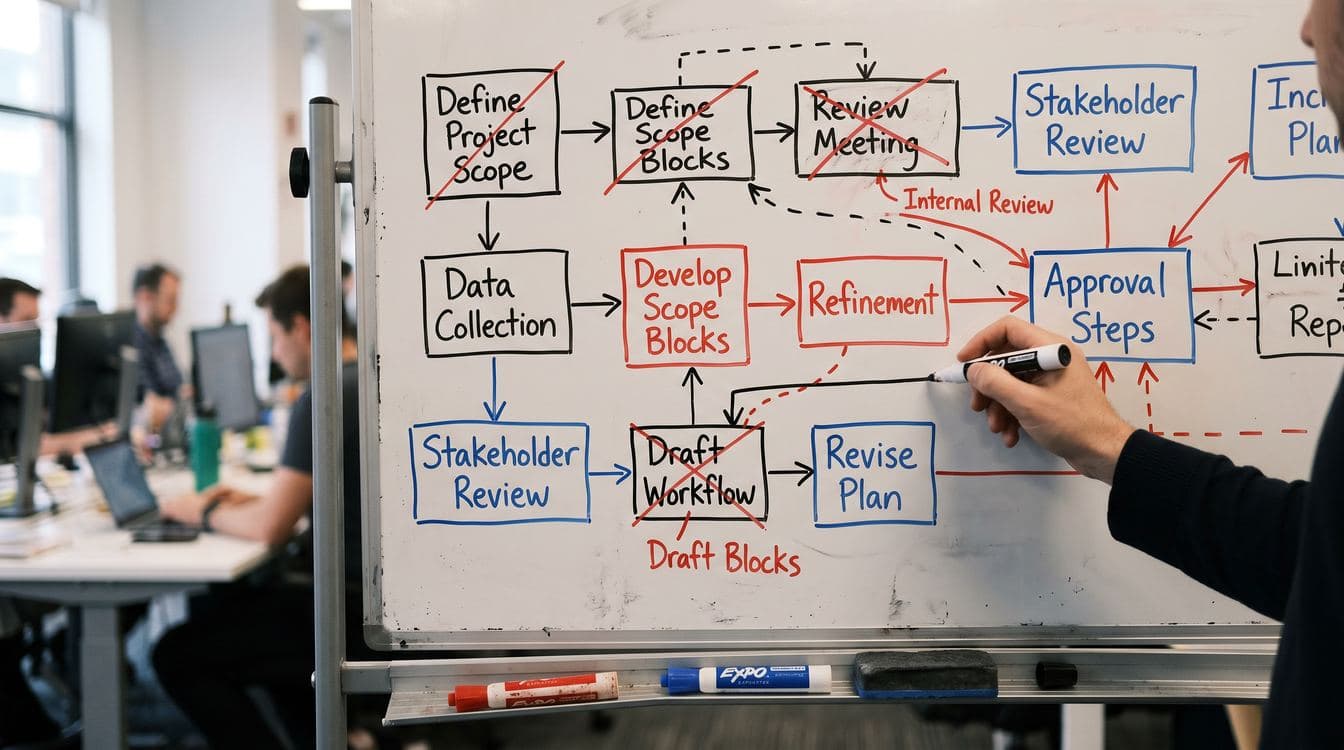
Push the approval bottleneck earlier. Most firms have the senior partner doing full proposal review right before it goes out. That's where the calendar delay lives: the partner is on site, or in client meetings, or traveling, and the proposal waits two days for a 45-minute read. Move the partner's involvement to scope block selection at the beginning of the engagement, not document review at the end. If the scope blocks are standardized and the partner approved them at the library level, the end-stage review becomes a 15-minute check instead of a rewrite.
What the Numbers Look Like When You Fix This
The QorusDocs 10th Annual Benchmark found that firms reporting meaningful proposal process improvements saw response times drop from an average of 9 days to under 4 days. The APMP/Loopio data shows that firms with structured content libraries and reusable content blocks submit proposals 40 to 50 percent faster than those without.
For a firm sending 25 proposals per month, cutting average turnaround from 10 days to 4 days is not a minor efficiency gain. It means you can respond to more opportunities in the same time. It means you're responding faster than competitors who are still in the partner-review queue. It means your junior staff are developing faster because they're working from vetted frameworks instead of guessing.
There's also a cost-side question worth modeling here. If your senior partners are spending 10 hours per proposal on review and rewrite, and you're doing 25 proposals a month, that's 250 hours per month of partner time, roughly $75,000 at a loaded cost of $300 per hour. A functioning scoping library can push that to 100 hours or less. The 150 hours you recover is either billable time or business development time for larger pursuits.
Where to Start This Week
You don't need to build the full library in week one. Pick one service line, your highest-volume offering. Write out the scope block language for the three most common engagement configurations. Get one senior person to review it. Make it findable. Then run two proposals through it and see what breaks.
That's one day of work to start. The compounding comes as you add service lines, refine the blocks based on actual usage, and shift your approval process to match.
The two-week proposal problem at your firm is fixable. It just requires treating scope knowledge as a firm asset instead of a partner habit.
If you want help building a scoping library or evaluating where your proposal process is leaking time, Granular works with mid-market professional services firms on exactly this kind of operational problem. Apply for the diagnostic and we'll walk through your current process before recommending anything.
Keep Reading
- Is Your Quoting Process Costing You Jobs? — How mid-market services firms diagnose and fix estimation and pricing problems that cause them to lose work on price before the scope conversation even starts.
- How to Capture Tribal Knowledge Before Key People Leave — A practical playbook for getting institutional knowledge out of senior employees' heads and into systems your whole team can use.